
3 Key Themes in Tennyson’s “The Eagle”

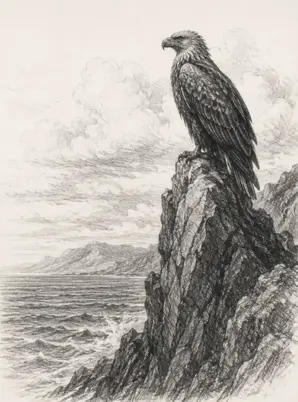
Alfred Lord Tennyson wrote “The Eagle” in 1851.
“The Eagle” is one of the shortest poems in English literature. Yet it conveys extraordinary depth through its vivid imagery and well-chosen words. In only six lines, Tennyson creates a striking image of an eagle high above the natural world. Readers consider not the literal description of a bird but rather broader concepts of human uncertainty.
 Themes of The Eagle
 Themes of The Eagle
Limitations of liberty and ambitions plus ephemeral life are among the most important topics in the poem. Each idea reveals a distinct facet of the eagle’s symbolic meaning. Tennyson articulates profound philosophical ideas through a simple, natural setting.
I. Natural Limits of Liberty
 I. Natural Limits of Liberty
For many years, the eagle has been Zeus’s symbolic companion, representing self-reliance and the capacity to transcend the mundane. The bird in the poem conveys an extraordinary freedom from terrestrial life. It has perched high amid the mountain peaks, “close to the sun,” like a god.
Evidence: This towering setting highlights the eagle’s supremacy over the earthly constraints.
Although it inhabits the wide-open sky, Tennyson does not portray the eagle as flying freely. Rather, this aged bird uses senile but strong claws to grasp the mountain. This implies that even a creature associated with total liberty is nonetheless a part of the real world. Thus, freedom frequently coexists with obligation or inherent limitations.
The poem also emphasises how nature’s laws are unavoidable. Despite its remarkable might, the eagle is still subject to the laws of nature. Even the strongest and most majestic creatures cannot exist outside of the forces that govern the natural world. Whether the fall is a dive toward prey or the force of gravity, it pulls the bird from its perch.
Evidence: The eagle’s abrupt descent “like a thunderbolt” in the final verse demonstrates that certain limitations can pull it down.
Although the eagle is a symbol of independence, its actions are influenced by instinct and natural order. This contrast implies that true freedom is never completely limitless. By mentioning both sides of great height with a sudden downward movement, Tennyson presents a contemplative view of freedom.
II. Limited Ambitions
 II. Limited Ambitions
Not only natural limitations, but also bodily limitations ultimately result in the downfall. The inner power and external appearance don’t always match. The eagle locates near the sun and high above the “wrinkled sea,” considering itself a majestic monarch of nature.
Evidence: “The wrinkled sea” crawling beneath the eagle and being “close to the sun” suggest its authority and dignity.
However, the eagle’s spirit may be stronger than its physical form. Its body is exhausted. It is perching exaltedly, but the talons are bent, standing in lands where no other can survive.
When the eagle abruptly “falls,” the tension reaches its peak. Whether the fall is intentional for the eagle’s quick plunge toward prey, or the body’s susceptibility to gravity, it accentuates abandoning its dominance over physical life.
Evidence: Icarus embodied in the eagle. Physical prowess is necessary for resilience and inner strength, since the body and spirit are connected.
III. Ephemeral Life
 III. Ephemeral Life
The eagle seems steady and enduring for the majority of the poem before abruptly moving. The environment, which changes very little over extended periods, encircles the bird. The eagle itself conveys a sense of steadiness and permanence and appears to fit in perfectly with this historic setting.
Regular rhythm, uniform line lengths, and a well-balanced rhyme pattern further reinforce the poem’s meticulous sense of harmony. So, the careful organisation of the language encourages readers to perceive the environment as serene and constant.
But with the last line, the mood shifts drastically. The eagle suddenly moves “like a thunderbolt.” The abrupt descent breaks the poem’s established serenity. It serves as a reminder that even in seemingly static situations, life is dynamic and ever-changing.
Once again, the binary of change and permanence is complementary. While living things act and respond to life’s needs, mountains, the sky, and the sea may seem enduring.
Tennyson mixes precise language with these universal interrelated ideas to give the poem depth. The poem continues to provide unique insights into the natural world and the human condition.
